

NormandyBunkers
Your guide to WW2 bunker sites & D-Day beaches
FuMG Auerhahn
One of the largest WW2 German radar complexes built in Normandy
FuMG Auerhahn site overview

What to see
Located north of the port city of Le Havre on the Cap d’Antifer cliffs, FuMG Auerhahn was one of the largest radar complexes built by occupying German forces during the Second World War.
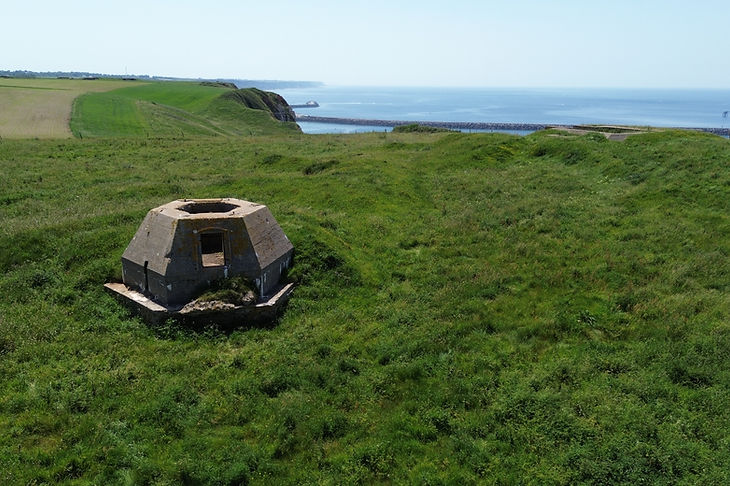
Auerhahn can be broken into three parts. Its northern sector – closest to the lighthouse - featured a FuMG Freya type radar, Wurzburg Riese radar stand, a L411 searchlight bunker, and several anti-aircraft gun positions with ammunition stores and personnel buildings.
At its southern end, this site features two large concrete roadblocks and a defensive Vf58c type Tobruk for a heavy machine gun, indicating there was originally a road or track running from the central site along the line of the current field boundaries and fences into this section of the complex.
The central site surrounds a large manor house and is located within agricultural fields where there were over 20 concrete constructions. While many are now buried in the fields, it once boasted a Wurzburg Riese and a Freya radar – both with L486 type radar HQ bunkers in support, plus a rare L479 bunker which was the base for the ‘Anton’ Luftwaffe night fighter guidance system.
Only five L479 bunkers were built in Normandy. The L479 is a very large bunker constructed over two levels and featured over 20 rooms including an ultra-modern (for the time) Seeburg plotting room. This was based around a large glass table with overlaid maps which would have lights shone upon them to highlight the movement of Allied and German aircraft. Operators within the bunker received their information from Wurzburg radars and relayed the tracking information back to the Luftwaffe pilots.
The L479 here is overgrown and is no longer accessible but you can go inside one of these bunkers at the superb Radar Museum at Douvres, behind the Sword Beach landing area in Normandy.
Located around the grounds of the private manor house were personnel shelters, air-raid bunkers, and ammo stores, along with an electricity transformer building and a handful of defensive MG positions, both field built and within Vf58c type Tobruks.
Auerhahn’s southern site is much smaller but contains some fascinating history.
This site was the location for Operation Biting, the British airborne raid of February 1942 where paratroopers landed in surrounding fields and fought their way to capture and escape via landing craft with then secret components from a mobile Wurzburg radar.
This radar was located near to a villa on the cliffs in the village of Bruneval.
Only the foundations of the villa can still be seen, along with some huge concrete constructions were built after the raid took place.
The largest structure built here was a L480 bunker, which is now buried and no longer accessible. The L480 is a multi multi-room, single storey building which supported a 200ft early-warning Wassermann S radar - a cylindrical chimney-like radar which consisted of up to eight Freya radars stacked around a column.
This design extended the range of detection from around 125 miles for a Freya to 190 miles/300km.
The column could also be rotated through 360 degrees for full coverage of the skies and were able to give detect the distance and height of enemy aircraft.
Surrounding the main structure were three anti-aircraft gun positions - two L409A types and a larger, two storey L410A bunker, each supporting 2cm Flak guns. This site cannot be accessed without permission as it is in private agricultural use.
A fourth site, known as FuMO Cap d’Antifer is located at the north of the Auerhahn complex around the lighthouse and features a small observation post – which now stands on the edge of the cliffs – and a V229 building, a small concrete construction which supported a huge Wurzburg Riese radar dish and cabin.
Gallery


