NormandyBunkers
Your guide to WW2 bunker sites & D-Day beaches
Fe03 Fecamp
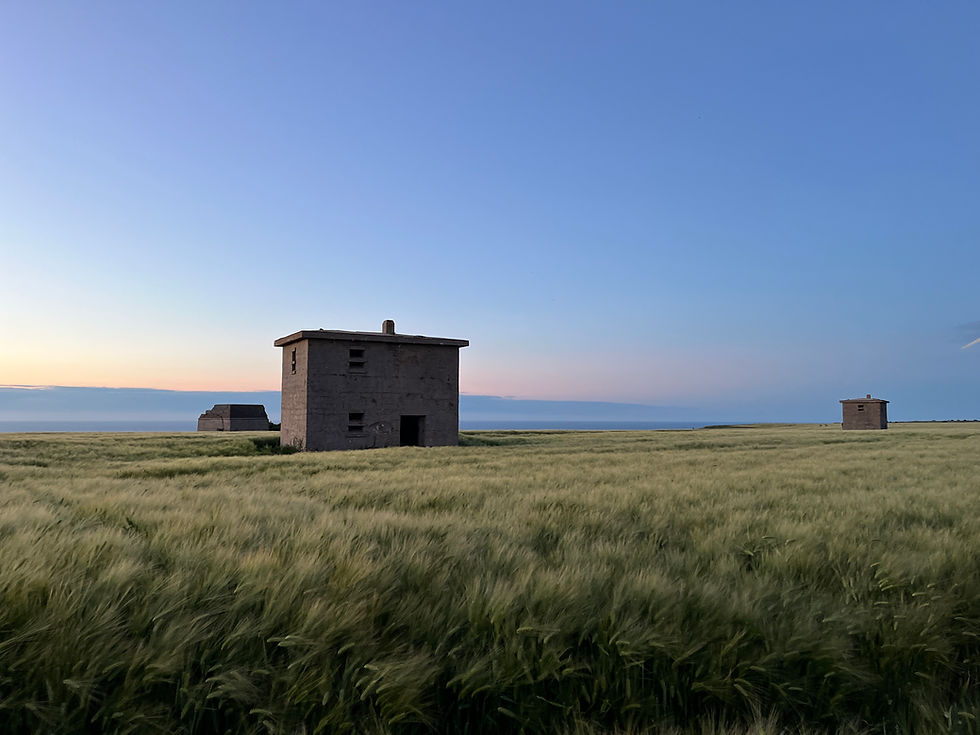
Big gun batterie with radio antenna buildings and bombing range

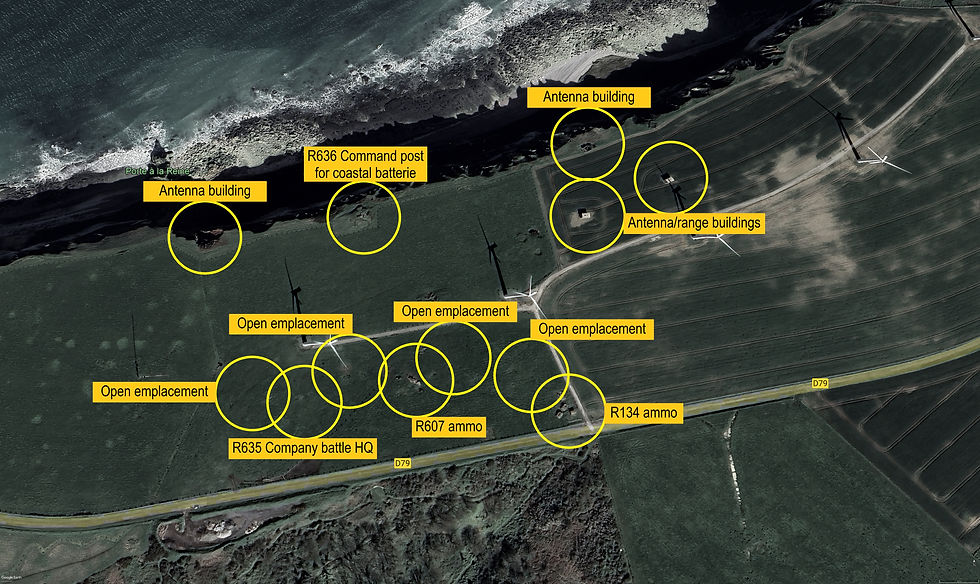
Fe03 Fecamp site overview

What to see
The beautiful port town of Fecamp is a popular holiday spot and for concrete tourists there's a lot to see including over a dozen gun casemates spread across the hillsides, a stack of casemates on the cliff edge, and a huge radar facility.
Fecamp was split into around a dozen different strongpoints with bunkers built to protect the town, on the edge of the hill to cover the port area, and on the cliffs at the top of Cap Fagnet where a mixture of defensive structures and radar bunkers still remain.
After the fortress ports of Le Havre and Dieppe, Fecamp was the third most fortified port in this area of Normandy. Fecamp was occupied between June 9, 1940, and September 2, 1944.
Fe03 is a site which runs along the northern edge of Cap Fagnet and has remains of two very different bunker sites within its boundaries, as well as buildings which could indicate the flat cliff top area was used for Luftwaffe training.
The most noticeable of the remaining structures are the two house-like buildings underneath the giant wind turbines.
The two-storey buildings here resemble houses rather than bunkers. Similar style buildings exist at a site known as Mont Etolan to the east of Cherbourg and this has led to some questioning whether the buildings were part of the huge radar complex which stands on the cliffs nearby, or that it hosted a radio guidance or a radio jamming system, or the flat clifftop area was used for target practice for training Luftwaffe bomber crews.
From images obtained from aerial reconnaissance in early 1944, Allied intelligence believed the Fecamp site was a jamming station with a large aerial positioned on the roof of each building.
Two brick buildings for FuMO24 antenna are also present at the Fecamp site so this could be the reason for the confusion. Incidentally, both these buildings are dangerously close to the cliff edge today and are on borrowed time before they fall.
Those who believe both Fecamp and Mont Etolan to be target ranges think the buildings would have been used as observation posts to check on the accuracy of the ‘bomb’ drops. The bombs in this case would have been training bombs made of concrete dropped onto markers in the open fields nearby.
Whichever of the theories are true, the site today is still there for all to see.
Closer inland and running alongside the D79 road are several destroyed bunkers and gun positions. These giant pieces of wrecked concrete include a rare R635 command post, R607 and R134 type ammunition storage bunkers and four open emplacements which were part of HKB batterie Senneville.
It’s believed that there were as many as six 15.5cm calibre field cannons here, all captured French weapons.
On the edge of the cliffs here you can also see a R636 command post for a coastal batterie which would have been the main observation post for the guns.
Gallery