NormandyBunkers
Your guide to WW2 bunker sites & D-Day beaches
U-Boat SM UC-61
WW1 German Type II U-Boat remains at Wissant

Location and info

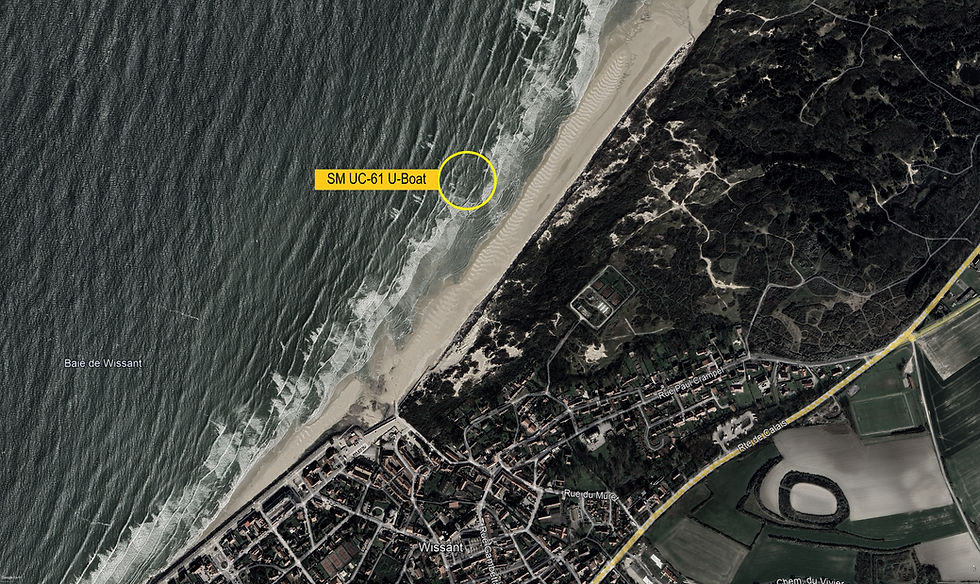
Located on the beach at Wissant
UC-61 can be accessed at low tide approximately 500m north east of the beach ramp in front of the dunes
It’s not often you get the chance to get up close to a First World War German U-Boat.
This Imperial German Navy submarine rests on the beach at Wissant – a beautiful town between Calais and Boulogne-sur-Mer in Northern France.
Seiner Majestät Unterseeboot No. 61 - His Majesty's Submarine 61 – was a Type UC II U-Boat, a class designed for coastal minelaying.
She was constructed at the AG Wesser works in Bremen and was one of 64 built between 1916 and 1917.
Laid down on April 3, 1916, she was launched seven months later, on November 11, and began her commissioned service on December 13 under the command of Lieutenant-Commander Georg Gerth.
Gerth was a career sailor, born in Berlin in 1888 he was to serve through both World Wars before retiring in 1944 as a Commander. He passed away in September 1970, aged 82.
UC-61 undertook five patrols under his command and is credited with sinking or damaging more than a dozen ships between March 5 and July 7, 1917.
These included the sinking of 10 merchant ships of British French, Italian, and Norwegian origin, along with the French warship ‘Kleber’ and the Royal Navy’s HMT Arfon, a requisitioned trawler.
The remains of UC-61 on the beach at Wissant – in two parts of around 30 feet total length - is only a tiny glimpse of what was once a mighty submarine.
Measuring over 51metres (170ft) long and 5.22m (17ft) wide with a draught of 3.67m (12ft), this 422 tonne vessel was one of the most advanced submarines of its time.
It was powered by two diesel and two electric engines which gave her a top speed of around 12 knots with a range of 8,000 nautical miles.
UC-61 was a formidable sub too, armed with six mine tubes and a complement of 18 UC200-type mines.
In addition, she had three torpedo tubes – two in the bow and one in the stern – and carried up 17 torpedoes. An 8.8cm L/30 deck gun completed her armament.
On July 26, 1917, she left Zeebrugge on an operation to lay mines near the British port of Newhaven on the south coast of England.
She was never to make her destination, instead running aground on the French coast at Wissant, over 60 nautical miles away from her target.
Instead of allowing the UC-61 to be captured by the French, the Captain decided to scuttle the ship, leaving her permanently stranded on the beach.
The crew of 26 – three officers including Lt Commander Gerth and 23 enlisted men - surrendered to the French and became prisoners for the rest of the war.
In September 1917, the wreck was used as a target for the testing of experimental anti-submarine mortars created by Belgian engineer Pierre van Deuren.
Firing from the beach at the submerged UC-61 he scored a direct hit which triggered one of the mines stuck inside the wreckage, causing massive damage to the sub.
A total of 64 type UC II U-Boats were planned and built during the First World War and UC-61 was one of 46 which were lost during the conflict.
During the post-war years, UC-61 slowly became buried on the beach and even though she came to rest less than 500m from the town, she was largely forgotten.
In December 2018, over a century since she came to rest, sections of UC-61 began to reappear due to shifting sands.
Today she can be seen during the lowest tides, with two small pieces believed to be from the stern area visible.
There have been many calls to excavate the site and raise the submarine, but the complexity and cost have proved prohibitive.
Check the tides and go see UC-61 at Wissant for yourself…
Gallery