

NormandyBunkers
Your guide to WW2 bunker sites & D-Day beaches
Wn34 Ver-sur-Mer
Historic lighthouse and bunkers inland of Gold Beach
Wn34 Ver-sur-Mer site overview

What to see
There isn’t much left that can be viewed by the public at Wn34 Ver-sur-Mer, but it was once an extensive defensive position inland of the beachfront bunkers of Wn33.
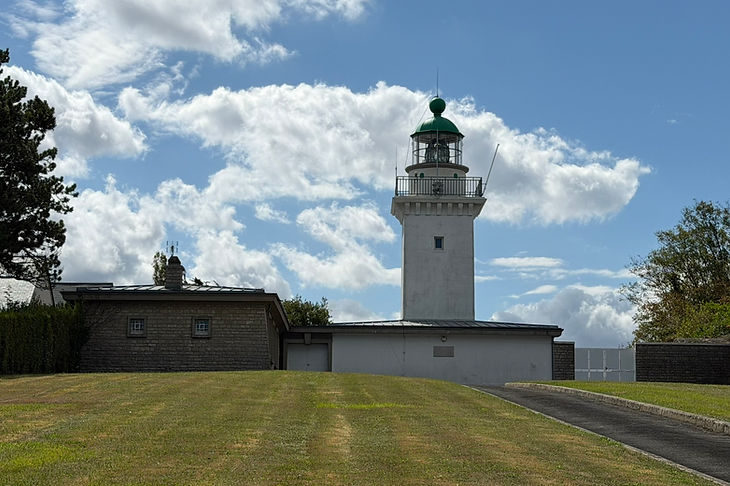
The site is based around Ver-sur-Mer’s 16m tall lighthouse, a building steeped in history itself.
The first lighthouse here was commissioned in 1836 and replaced a semaphore station. In the early 1900’s a new lighthouse entered service, and it was this building which was integral to an amazing story of the first transatlantic airmail flight from New York to Paris in June 1927.
With thick blanket of fog over Paris the Fokker aircraft known as ‘America’ circled in search of a safe place to land and eventually spotted the light from the Ver-sur-Mer lighthouse. Ultimately, this beacon of hope would end in disaster as the aircraft landed on what they thought was the wide, sandy beach at Ver-sur-Mer, but they failed to notice the tide was in and so ditched in the sea off the town instead. This amazing story is told in the Musee America and Gold Beach in the town.
It’s here you can find out more about the bunker site Wn34 too through period images and research by the museum’s historians.
Wn34’s main defence came from a 5cm KwK anti-tank gun located in Type 1694 Ringstand on the north west corner of the complex plus a platform for a 7.5cm field gun which could be rotated to fire in all directions to help prevent ingress inland from the beach or slow any attack form the rear. Both now stand in private gardens or under modern developments.
The site also boasted four Tobruk type defences, two front-facing Ic116 type for heavy machine guns on a central pivot and a Bf58c type where the MG was mounted on a circular ring. These were created to stop any unwanted movement along the main road – now the D112.
A third Ic116 type was located to the south west corner of the site, and this is the only one which can still be seen by the public today. However, it stands in an agricultural field and is heavily overgrown so can’t be accessed easily.
Around the base of the lighthouse – and still there today – are three concrete shelters, one which has a Bf58c type Tobruk on top. This Tobruk had an additional 89P9 type armoured observation cupola.
The site also featured a large complex of wooden barracks in land immediately west of the lighthouse, but these have long since disappeared from Wn34.
The current lighthouse was damaged during the D-Day bombardments and landings but was refurbished in 1950. It is off limits to the public.
Gallery


